
América Is A Continent
My name is Jordan Guillén-Reeves and I’m the Managing Director at Guillén Paz. I sat down with my husband, Luis, the Creative Director, to talk about what’s most important to us: our impact. But before we dive into the conversation, here’s some context.
Our mission at Guillén Paz is to celebrate and preserve the culture and heritage of Latinoamérica.
That means creating products that are inspired by Latinoamérica — the art, the music and dance, the literature, the food, the animals and plants. Luis’ designs are expressions of how he sees places like Honduras, his home country. But the love he has for Honduras is shared with every country in Central America.
As a matter of fact, Luis and I both believe that the borders that separate the countries of the Americas are divisive. Too often these days, borders are used as excuses to keep people out. They are tools that people use to separate us from each other. Our hope at Guillén Paz is for a world that is more connected. Where every place feels like home no matter where you were born.
At Guillén Paz, we believe that América is a continent. And moving freely between North, Central, and South America should be as easy as moving from one part of your house to another.
“When we say ‘América is a continent,’ we are honoring a deep, ancestral community that existed long before borders were drawn. We share a language, a history of overcoming, and a future we are building together.”
The challenge is that borders are probably not going anywhere, so for the foreseeable future, we still face the tremendous challenges of navigating a world divided by geopolitical lines. Even still, humans migrate. It’s just part of being who we are.
“As of June 2025,” according to Pew Research Center, “51.9 million immigrants lived in the U.S., making up 15.4% of the nation’s population.”
Interestingly, many countries “have a higher proportion of immigrants in their populations than the U.S. does. In neighboring Canada, for example, immigrants account for 22% of the population. And in the United Arab Emirates, about three-quarters of all residents were born elsewhere… about half of all U.S. immigrants (52%, or 26.7 million people) were born in Latin America. In addition to the [11 million] migrants from Mexico and Cuba, more than a million hail from El Salvador (1.6 million), Guatemala (1.4 million), the Dominican Republic (1.4 million), Colombia (1.2 million), Honduras (1.1 million) and Venezuela (1.1 million).”
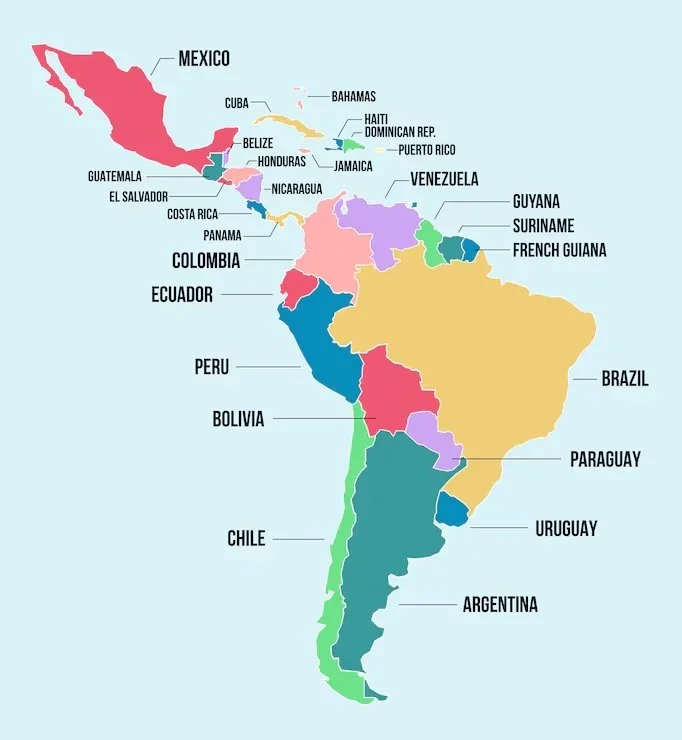
According to The Guardian, reports from the UCLA Luskin School of Public Affairs and the American Immigration Council, show that up to 93% of all ICE interior arrests and detentions target Latinoamericanos. Research shows that the vast majority of these arrests and detentions are concentrated among individuals from Mexico, Guatemala, Honduras, and Venezuela.
The reasoning behind the disproportionate targeting of Latino communities is complex to say the least. I found experts saying it was a mixture of the shared border, local law enforcement partnerships, visibility of labor, and the geopolitical crises. But the reason that seems most plausible to me is racial profiling of Latino people.
There’s even legal protection for federal agents who use what we have otherwise deemed as profiling. According to Cornell Law School’s Legal Information Institute, “the term ‘Kavanaugh stop’ refers to the practice whereby federal immigration officers may stop someone based on perceived factors such as their presence at specific locations, occupation, spoken language, and ethnicity, to inquire about their immigration status.”
While we are outspoken in our disapproval of this kind of treatment of any human, the particular disproportionate affect current arrests and detainments are having on Latinoamericanos is a direct affront to our mission at Guillén Paz. If we exist to celebrate and preserve the culture and heritage of Latinoamérica, then we must start by protecting our people — those that create the culture in the first place.
I sat down with my husband to talk about what this means and what we are doing, as a company, to help.
Jordan:
Hi, babe. Welcome to your first interview for the Guillén Paz blog. To kick us off, introduce yourself and tell us what you do here at Guillén Paz.
Luis:
Hola, everyone! I’m Luis, and I’m the Creative Director.
Jordan:
For those of you that don’t know, that means that Luis designs all of the collections for Guillén Paz. So far, there are two. Luis, can you tell us a little bit more about Mi Gente, and then I want to dive into The Community Impact Collection.
Luis:
Mi Gente is the very first collection I developed for Guillén Paz. It’s about all of the experiences of my life, from my childhood until now. All the experiences that have shaped me. They have shaped my creativity. The flavors, the colors and sounds. The people around me. It’s about how Latin America is home for me. It brings together all these feelings and values to the front of my mind. I realized that when I left Honduras, I brought them with me to the United States. They have helped me get to where I am in my life. Not just this place, but the ability to grow into the most expansive version of myself. I dedicate this collection to my people. Latinoamericanos. Mi gente.
Jordan:
If you haven’t already, I highly recommend you check out more about Mi Gente on our blog. Now I want to shift gears a little bit and talk about The Community Impact Collection. Luis, can you tell us what that is and why it’s important to you.
Luis:
The Community Impact Collection is what we developed to give back and support our community. They have supported us, and now we want to support them. The mission of Guillén Paz is to celebrate and preserve Latin American culture and heritage. So, the purpose of the CIC is to raise awareness about what’s going on in our community with ICE and to raise money to help those who have been detained pay their legal fees. Especially those that do not have the resources to do it on their own.
Jordan:
So why does the tshirt say “América Is A Continent”?
Luis:
I remember that I was taught in school that we live on one big continent called América. That’s probably why when I look around, I don’t see borders. I just see how we are connected. The things that bring us together. Sure, we have diversity in culture, food, music, colors. But that’s one of the reasons I love to meet new people. And when we get to know each other, we realize that we all share roots. We can trace some things across entire regions, regardless of borders. Like eating corn. Some make tortillas. Some make empanadas. Some make soup. But the base is the same. Just corn. So, here we are. We’re all, in a way, eating the same corn. We’re all sharing a big piece of land called América. To me, it’s important to reframe it because so many are convinced that borders are excuses to keep people out. But what if they were invitations to invite those who looked different, sounded different, and had different experiences into our neighborhoods? Into our homes?
Jordan:
I remember visiting Iran with my dad in 2003. There was a brief window of time when U.S. tourists could visit, and we spent 2 weeks traveling across the country in a big tour bus. The generosity of the people was so heartwarming. They invited us into their homes for tea and dried apricots. All of the noise in the media about the Middle East at that time seemed to disappear when we got to know the people. These days, there’s so much noise in the media about Latin Americans. What do you think is one big misconception about people from Latin America, and what’s the thing you love most about them?
Luis:
The biggest misconception is that we are dangerous. That we come to the U.S. to create harm. That’s just not true. There’s dangerous people everywhere. Hurt people hurt people. But what I see in Latin America is sweet people. Hard workers. People that love passionately. People with delicious food. Loud people. People with great rhythm on the dance floor. People who are not afraid to make you feel like family from the moment they meet you. We always say, “My house is your house, and you’re always welcome.” So not matter where I go, when I find my people, I feel at home. That’s what I love most about Latinoamericanos.
Jordan:
I love the mission of Guillén Paz. To celebrate and preserve Latin American culture and heritage. Of all the things we could have focused on, why are we standing in solidary with those arrested or detained by ICE and helping with their legal defense funds?
Luis:
As an immigrant, this is a very personal experience for me. To try and find a place to grow and live my life can be scary. I relate with the experience of so many who have come here to find the life they want to live. The chance to grow and build something. I haven’t been detained, but I live with the fear that I might be.
Jordan:
I can’t imagine what that must feel like. I’m so sorry. But thank you for this effort to make the world feel more like home to Latinoamericanos. How does this tie back to Guillén Paz’s mission?
Luis:
The most important part of Guillén Paz, to me, is the impact we have. Not creativity. Not profit. Impact. When we started this company, we talked about creating something that would support our community. We wanted to create a legacy company that would continue to support — protecting, feeding, celebrating, and giving freedom — to our people. I can’t imagine a better way of celebrating and preserving Latin American culture and heritage than by helping Latin Americans live the life of their dreams without the kind of fear we all feel because of ICE.
Jordan:
Tell us what’s next. How can people support the Community Impact Collection?
Luis:
First of all, there are so many ways to support the community. If you’re not already in community with Latinoamericanos, go meet some. Get to know the music and the food. The movies. The fashion. Fall in love with the culture that we are dedicated to celebrating. Then, it’s very easy to see why Latinoamericanos are so easy to love. That’s the biggest way any of us can help. And it will cost you nothing but your time. We would also love it if you stayed in touch with us. Get involved with us on social media and our blog. Come to our events. We are launching so much right now, and we want you to be a part of it. As a community, we can keep taking care of each other. Oh, and buy the tshirt.
Jordan:
Thank you, babe. I love doing this with you. Thank you for your vision and your heart for people.
Luis:
Thank you, my love, for being down to build something that’s bigger than us as a couple. Something that’s bigger than either one of us. Thank you for building this legacy with me. Thank you for building something that will help our community have better opportunities. And thank you to everyone in our community. We don’t want to do this without you.